How Long, Not How Close:
A Learned Temporal Metric for Planning in Latent World Models

Lama Moukheiber1, Haotian Xue1, Yongxin Chen1

1

A latent world model predicts what happens next, but its planning cost cannot tell how far the goal is. TEMPO teaches it, without touching the model.

11
environments, navigation
to 3D manipulation
36→99%
LeWM on TwoRoom,
three plans from the goal
17→75%
LeWM on cross-room,
three plans from the goal
0.13M
parameters added,
world model left frozen
≤0.3%
extra arithmetic
per plan

The problem

Far from the goal, the planner walks into the wall

Latent world models like LeWM and PLDM pick the plan whose imagined end state looks most like the goal. Up close that works. Move the goal a few plans away and success collapses.

Latent distance asks

"How much does your end state look like the goal?"

Several plans away, the best-looking state is pressed against the wall, dozens of steps from the goal.

TEMPO asks

"How many steps are you from the goal?"

Every short plan is ranked by how much of the task it leaves, so the chain of plans follows the real route.

The collapse comes from the cost the planners share, not from any one world model. So we fix the cost and leave the model alone.

The method

A small map that counts steps, blended into the planner's cost

Same start, goal and frozen LeWM model; only the planning cost differs

Real rollouts; replays match the paper's results.
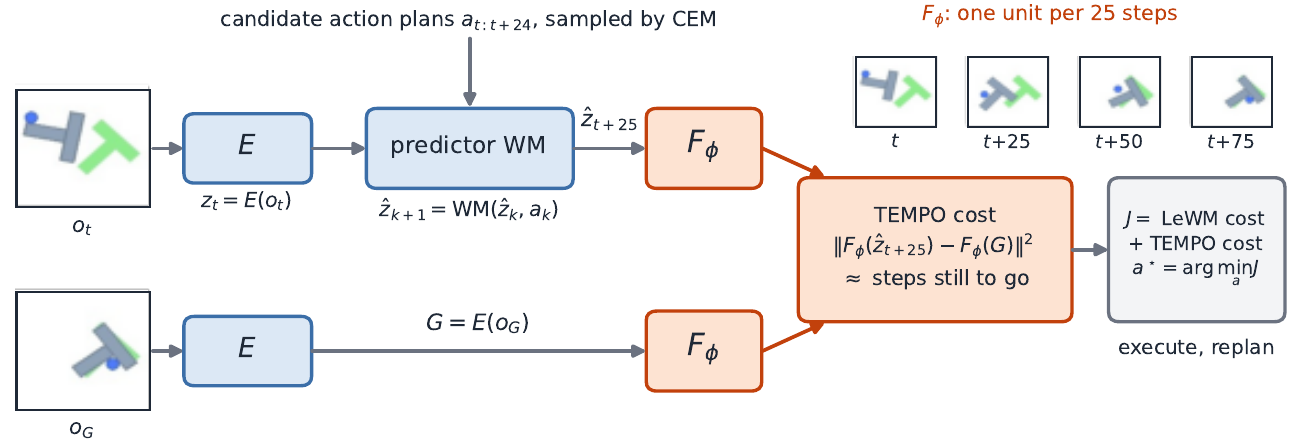
Show where TEMPO sits in the planner TEMPO in the planner.

LeWM's frozen encoder $E$ and predictor $\mathrm{WM}$ are unchanged and nothing is decoded. TEMPO adds the map $F_\phi$ (orange) and scores each CEM candidate by how many steps its end state still is from the goal.

1

Learn to count steps

A tiny network learns a distance that counts environment steps.

Details

$F_\phi$, a two-layer MLP on the frozen 192-d latent, is trained so that the distance between two frames of the same episode equals the steps between them, one unit per 25-step plan: targets $k/\kappa$ with $\kappa = 25$, up to $75/\kappa = 3$. Pairs more than 75 steps apart are only pushed at least 3 units apart, so a state beyond three plans never looks closer than one within range.

2

Blend into the cost

Add that distance to the planner's usual latent cost.

Details

The planner minimises

$$J = (1-w)\,\lVert \hat z_{t+H} - G\rVert^2 \\ +\, w\,\bar d_H^{\,2}\,\lVert F_\phi(\hat z_{t+H}) - F_\phi(G)\rVert^2$$

with $w = 0.5$. The latent term keeps the fine positioning manipulation needs; the temporal term orders plans by how far they still are from the goal.

3

Plan exactly as before

Same frozen model, same search. Nothing else changes.

Details

Same frozen world model, same CEM, same horizon, same replanning. No rewards, policies, success labels or environment state: only the time steps of the trajectories the world model was already trained on.

World model stays frozen No rewards or success labels Same data as the world model ≤0.3% extra arithmetic per plan Works with LeWM and PLDM

Results

Better at every goal distance, on both planners

Eleven environments, from maze navigation to 3D manipulation, evaluated on identical windows one, two and three plans from the goal. Each TEMPO run keeps the planner and changes only the cost it minimises.

Planner + TEMPO (ours)

Success rate (%), mean over 3 seeds × 5 groups of 50 windows. Wall has no three-plan setting.

Full results tables (mean ± standard error)

Standard tasks

Planner TwoRoom Reacher Push-T Cube Scene Avg. Δ
LeWM
one plan87.7±0.894.7±0.793.6±1.074.8±2.469.6±1.184.1–
+ TEMPO (ours)97.2±0.695.5±0.795.1±0.677.1±1.771.1±1.187.2+3.1
two plans58.5±1.795.7±0.649.7±1.357.9±2.456.4±1.263.7–
+ TEMPO (ours)99.2±0.396.8±0.555.7±1.258.7±2.057.9±1.373.7+10.0
three plans36.3±2.389.7±0.422.0±0.668.7±1.648.7±1.353.1–
+ TEMPO (ours)99.2±0.398.4±0.528.1±2.070.4±1.250.5±1.369.3+16.2
PLDM
one plan96.8±0.493.6±1.076.1±1.860.3±2.356.1±1.876.6–
+ TEMPO (ours)98.9±0.394.5±1.090.1±1.268.7±1.458.4±1.382.1+5.5
two plans82.0±2.093.6±0.631.9±1.548.5±1.743.6±0.959.9–
+ TEMPO (ours)97.2±0.598.0±0.439.5±1.848.7±1.845.9±1.265.8+5.9
three plans70.5±1.488.0±0.511.6±1.365.6±1.738.7±1.754.9–
+ TEMPO (ours)95.7±1.197.7±0.517.1±1.766.7±2.041.1±1.563.7+8.8

More complex tasks

Cross-room TwoRoom is PLDM's Two-Rooms evaluation, with the goal always in the other room (budgets of 50, 100 and 150 steps). † Wall episodes end at 50 steps, so its two-plan cell uses goal 40 and it has no three-plan cell.

Planner Wall† TwoRoom cross-room PointMaze M PointMaze L Ant-U Avg. Δ
LeWM
one plan67.6±1.412.0±1.032.1±1.428.0±2.019.7±1.031.9–
+ TEMPO (ours)75.7±2.246.5±1.275.7±1.754.8±1.621.9±1.154.9+23.0
two plans57.7±2.415.5±1.017.6±1.02.9±0.625.5±1.523.8–
+ TEMPO (ours)65.9±2.269.6±1.841.1±2.021.3±1.229.6±1.045.5+21.7
three plans–17.1±1.110.8±0.80.3±0.228.1±1.614.1–
+ TEMPO (ours)–74.5±1.731.7±1.06.5±1.034.0±2.136.7+22.6
PLDM
one plan71.2±1.923.9±1.522.8±2.132.3±1.517.1±1.533.5–
+ TEMPO (ours)82.3±1.742.5±1.543.1±1.848.5±2.918.5±1.747.0+13.5
two plans63.5±2.435.2±1.716.8±1.06.5±0.724.3±1.129.3–
+ TEMPO (ours)72.5±1.462.0±1.626.9±2.115.1±1.829.3±1.741.2+11.9
three plans–39.1±1.88.7±0.83.1±0.826.8±1.519.4–
+ TEMPO (ours)–65.1±1.716.7±0.87.1±1.029.3±1.729.5+10.1

Generalisation

Trained on one layout, still useful on the next

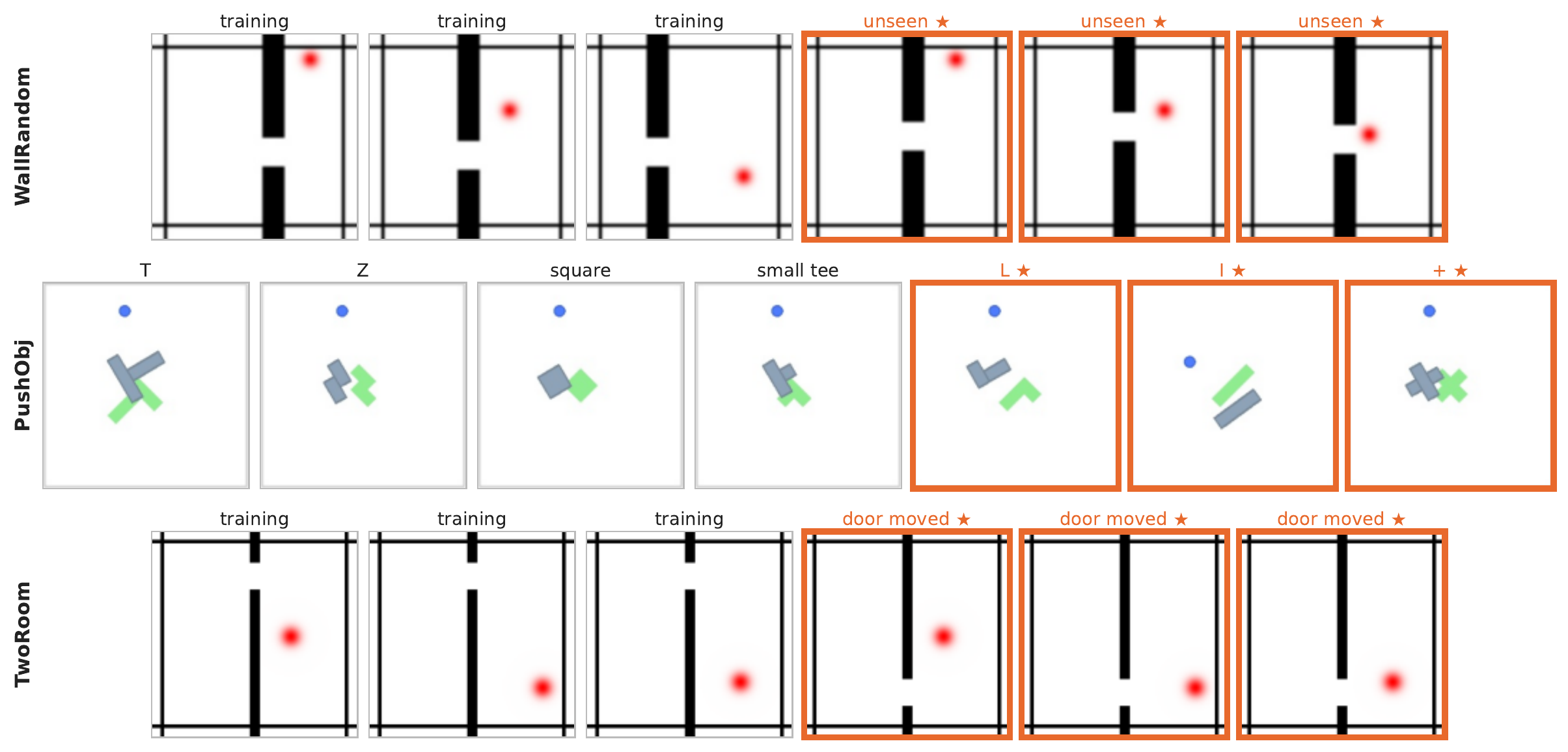
Training and test setups for WallRandom, PushObj and TwoRoom with a moved door.
Unseen configurations are outlined in orange: wall and door positions outside every training range (WallRandom), the L, I and + block shapes (PushObj), and a door moved to the opposite end of the wall (TwoRoom).

Unseen layouts

Substantially improves the LeWM planner on unseen wall layouts and on the cross-wall test, and both planners three plans out with a moved door.

Unseen shapes and shifts

Improves PLDM on unseen block shapes, and keeps its advantage under blur, colour jitter, a larger agent or a heavier arm.

Kitchen robots

Improves both planners on RoboCasa Pick-and-Place and Kitchen-Nav with a mobile manipulator, at every goal distance.

Takeaways

Fix the cost, not the model

BibTeX

@article{moukheiber2026tempo,
  title   = {How Long, Not How Close: A Learned Temporal Metric
             for Planning in Latent World Models},
  author  = {Moukheiber, Lama and Xue, Haotian and Chen, Yongxin},
  journal = {arXiv preprint arXiv:2610.04988},
  year    = {2026}
}